
Digital marketing in 2026 has evolved far beyond simply posting on social media or running paid ads. Today, it is powered by artificial intelligence, advanced automation, deep data analytics, and hyper-personalized customer experiences. The digital landscape is more competitive than ever, and businesses that fail to adapt risk becoming invisible in a crowded online marketplace.
Consumers now expect brands to understand their needs, anticipate their behavior, and deliver value instantly. At the same time, privacy regulations and shifting technologies are reshaping how marketers collect and use data. This creates both a challenge and an opportunity: brands must become smarter, faster, and more strategic.
In this blog, we’ll explore the most important digital marketing trends shaping 2026 and outline what your business must do to stay ahead of the curve.
Key Trends in Digital Marketing (2026)
Here’s a quick overview of the major trends and their impact:
| Voice & AI Search | Changing search behavior | ⚡ Medium |
| AI Content Generation | Automated blogs, ads, and captions | 🔥 High |
| Personalization | Hyper-targeted content | 🔥 High |
| Short-form Video | TikTok, Reels dominance | 🔥 High |
| First-party Data | Privacy-focused marketing | 🔥 High |
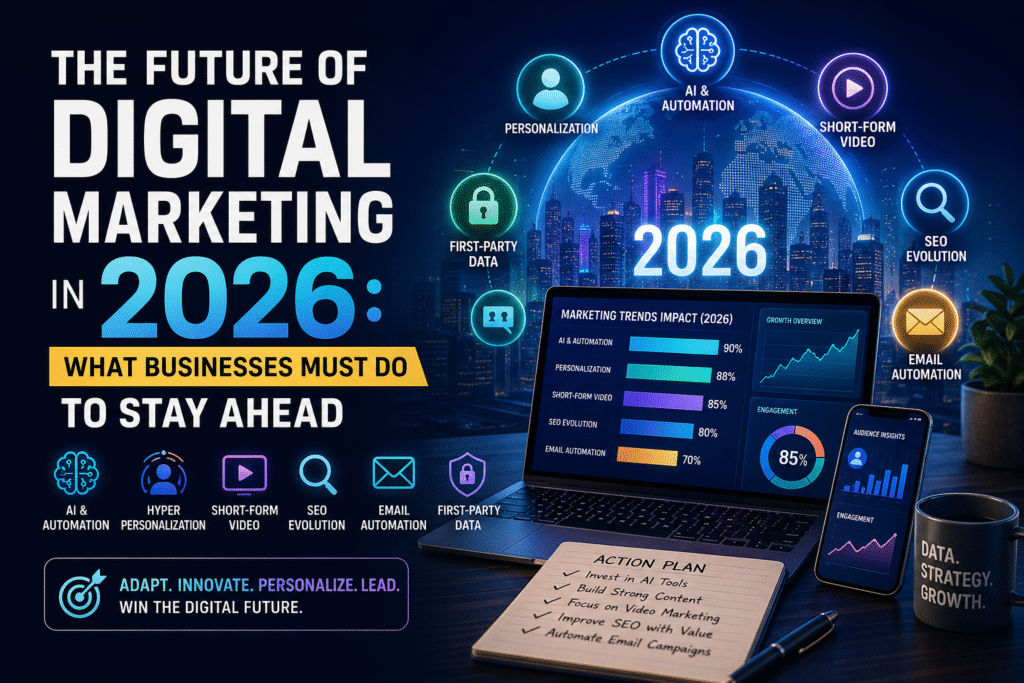
Trend Impact Overview
- AI & Automation: 90%
- Personalization: 88%
- Short-form Video: 85%
- SEO Evolution: 80%
- Email Automation: 70%
These numbers highlight one clear reality: automation and personalization are no longer optional they are essential.
1. AI is Dominating Content Creation
Artificial intelligence has become the backbone of modern digital marketing. Businesses are now using AI tools to streamline and scale their content production like never before.
What AI Can Do Today
AI tools can now:
- Generate blog articles in minutes.
- Create social media captions and campaigns.
- Write email sequences and newsletters.
- Analyze customer behavior and suggest content strategies.
This dramatically reduces the time and cost required to produce content at scale. However, while AI is powerful, it is not perfect.
The Human Touch Still Matters
AI lacks true emotional intelligence and brand nuance. That’s why human oversight is still critical. Businesses that combine AI efficiency with human creativity produce the best results.
The winning formula in 2026 is:
- AI for speed and data
- Humans for storytelling and authenticity
Brands that rely solely on automation risk sounding robotic and disconnected from their audience.
2. Personalization is No Longer Optional
Consumers in 2026 expect brands to speak directly to them—not to a general audience. Generic messaging simply doesn’t work anymore.
What Customers Expect
Today’s audience demands:
- Personalized product recommendations
- Customized email campaigns
- Content tailored to their interests and behavior
Example: Generic vs Personalized Marketing
| “Buy our product” | “Hey John, here’s a solution for your business” |
Personalization increases engagement, builds trust, and significantly improves conversion rates.
How Businesses Can Personalize Effectively
To succeed with personalization, businesses must:
- Use customer data responsibly.
- Segment audiences based on behavior and interests
- Leverage AI tools for dynamic content delivery
The key is making customers feel understood—not targeted.
3. Short-Form Video is King
Short-form video continues to dominate digital platforms in 2026. Attention spans are shorter, and audiences prefer quick, engaging, and visually dynamic content.
Leading Platforms
The most influential platforms include:
- TikTok
- Instagram Reels
- YouTube Shorts
These platforms prioritize video content in their algorithms, making them essential for visibility.
Content Performance Comparison
| Text Posts | 2–3% |
| Images | 5–7% |
| Video | 10–20% |
Video clearly outperforms other formats by a wide margin.
Why Video Works
Short-form video is effective because it:
- Grabs attention instantly
- Delivers information quickly
- Feels more authentic and relatable
What Businesses Should Do
To stay competitive:
- Invest in video content creation.
- Focus on storytelling, not just promotion.
- Keep videos short, engaging, and value-driven
Brands that ignore video marketing risk losing relevance.
4. SEO is Evolving (Not Dying)
There’s a common misconception that SEO is becoming obsolete due to AI tools and voice search. In reality, SEO is evolving—not disappearing.
What’s Changing
Search engines are becoming smarter, focusing less on keywords and more on:
- Search intent
- Content quality
- Authority and credibility
AI-powered search tools now prioritize answers that provide real value rather than just optimized keywords.
What Matters in 2026 SEO
To rank effectively, businesses must focus on:
- Creating high-quality, helpful content
- Demonstrating expertise and trustworthiness
- Understanding what users are actually searching for
The Shift from Keywords to Value
Old SEO:
- Keyword stuffing
- Basic blog posts
New SEO:
- Problem-solving content
- Deep, informative articles
- User-focused experiences
Businesses that prioritize value over manipulation will win in search rankings.
5. Email Marketing is Still Powerful
Despite the rise of new platforms, email marketing remains one of the most effective digital marketing channels.
Why Email Still Works
Email offers:
- Direct communication with your audience
- High return on investment (ROI)
- Full control over your messaging
Unlike social media, where algorithms limit reach, email allows you to reach your audience directly.
The Role of Automation
Modern email marketing relies heavily on automation:
- Welcome sequences
- Abandoned cart reminders
- Personalized product recommendations
Automation ensures consistent communication while saving time.
Best Practices for 2026
To maximize email performance:
- Personalize your emails
- Segment your audience
- Focus on providing value, not just selling.
Email remains a cornerstone of a strong digital marketing strategy.
The Rise of First-Party Data
With increasing privacy regulations and the decline of third-party cookies, businesses must rely on first-party data.
What is First-Party Data?
First-party data is information collected directly from your audience, such as:
- Email sign-ups
- Website behavior
- Customer preferences
Why It Matters
First-party data is:
- More accurate
- Privacy-compliant
- Highly valuable for personalization
Businesses that build strong data strategies will have a significant advantage in 2026 and beyond.
What Businesses Should Do Now
To stay competitive in this rapidly evolving landscape, businesses need a clear action plan.
✅ Action Plan for 2026
| 1 | Invest in AI tools |
| 2 | Build a strong content strategy |
| 3 | Focus on video marketing |
| 4 | Improve SEO with value-driven content |
| 5 | Automate email campaigns |
Additional Strategic Moves
Beyond the basics, businesses should also:
- Build strong brand authority.
- Focus on customer experience.
- Continuously analyze and adapt strategies.
The key is not just adopting trends but integrating them effectively into your overall marketing strategy.
Conclusion
Digital marketing in 2026 is smarter, faster, and more personalized than ever before. Success is no longer about who shouts the loudest it’s about who delivers the most value in the most relevant way.
The future belongs to businesses that:
- Adapt quickly to change.
- Use AI strategically
- Focus on building genuine customer relationships.
Brands that embrace innovation while staying human-centered will stand out in an increasingly automated world.
Ultimately, the goal is simple: deliver the right message to the right person at the right time.
Businesses that master this will not just survive they will lead.